
An AI pilot may work with a small group that knows its limitations. Daily operation adds shift changes, missing records, busy reviewers and system outages. A release plan should test those conditions and make ownership clear before the user group grows.
Define the workflow and its clinical boundary
Document what the system prepares, who reviews it and whether its output can affect care. Keep administrative assistance distinct from clinical judgment. Obtain the appropriate clinical, privacy and security review for the actual use. A low-risk description is not sufficient if staff are expected to rely on the output for a consequential decision.
Test with representative operating conditions
Use the document formats, incomplete records and unusual requests the team encounters. Include service interruptions and delayed review. Evaluate whether the output is useful and whether the process stays safe when the normal path is unavailable. Keep a stable acceptance set so that later changes can be compared with the release decision.
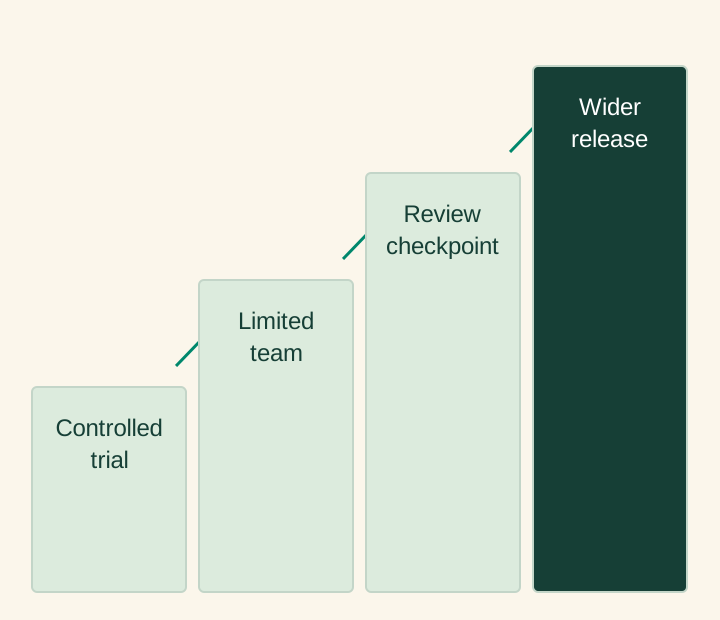
Introduce a controlled rollout
Begin with a defined team and explicit support coverage. Make the review obligation visible in the interface and training. State how the workflow can be paused and how work returns to the established process. Monitor unresolved cases and reviewer corrections alongside throughput so that operational pressure does not conceal a quality problem.
Rehearse a busy-day failure
Run the workflow when an upstream system is unavailable or a reviewer cannot complete the normal handoff. Verify where the request waits, who receives an alert and how duplicate processing is prevented. The team should know whether work is delayed, safely returned to a manual process or requires escalation.
Then review a case in which the AI package is accepted and later corrected. Can the organization identify the relevant source, configuration and reviewer disposition? Can it update the process without losing the original record? These exercises connect reliability and accountability to the health system’s day-to-day operating conditions.
Make ongoing ownership concrete
Name the people responsible for source updates, access changes, incident review and new releases. Check the complete data path, including retained prompts and logs, against the approved handling arrangements. HHS cloud guidance is a starting reference for the data review; the health system must assess its own configuration and obligations.
Before the next decision
Planning checklist
- Clinical and operational owners assigned
- Acceptance cases covering incomplete records
- Supported rollout and manual fallback
- Source, access and release maintenance plan
Sources and further reading
Sources checked 5 October 2026. The design recommendations in this guide are AID’s analysis. Sector obligations depend on the use case and jurisdiction.
Apply this to a defined workflow
AID can turn a bounded pilot into a documented release plan with acceptance evidence, operating ownership and handover.